Showing posts with label books for kids and adults. Show all posts

Thursday, October 11, 2012

Taylors Falls Historical Society

After doing a morning program at Lakeville Senior Center last Friday, Nancy and I drove up to Taylors Falls, where we were scheduled to do a Farm Heritage Program for the Taylors Falls Historical Society after their 6:00 PM Volunteers Recognition Dinner at the Taylors Falls Community Center, which used to be the old depot.
We expected a beautiful display of leaves in the area, and we weren't disappointed, even though local residents assured us that we missed the peak by about a week.
Photo taken through the windshield as we drive toward Taylors Falls.

Overlooking the St. Croix River from a park north of Taylors Falls.

As we drove into the parking lot of the Community Center, we could see workers inside preparing the table layout for dinner.

The depot rests on the hillside on the edge of town. It's a picturesque setting, and since we were early, we decided to walk around the area before going in to set up.

Impressed with the area's beauty and the main street shops, we decided to put Taylors Falls on our list of towns to visit next summer.

Board Member Fay Caneday greeted us when we came in the door, and she helped us get settled as we set up our display.
Our book and photo display is on the left and extends to center. The table at the far end of the picture, extending to the right of the photo, contains the museum's photos and tools, which we found very interesting.
This is a corn sheller exactly like the one my folks bought me when I decided to raise ducks. 
Turning the handle was easy and corn-shelling went fast, but I had to be careful not to let the sharp teeth catch my clothing. Even though it was hand-powered, the momentum of the wheel could still draw blood if the teeth caught your fingers.

The table setting at the old depot provided a nice setting for 57 guests as Fay began the program (above), and as I began my program (below).

Nancy and I had a great time visiting with people, and we have never been any place where people were more willing to tell their stories to us. I think the small farm heritage runs pretty close to the hearts of the people in the Taylors Falls area.

We wish to thank Fay Caneday for arranging our visit, and we thank everyone who attended the dinner for being such a fun audience. We especially thank all those people who bought my books and stopped to give me a few kind words after my program.

Taylors Falls is a beautiful area to visit, and it has several historic places to see in addition to the riverside parks and walkways. You may want to put it on your list of places to visit just like Nancy and I did.

Photograph by Nancy A. Fredrickson


Tuesday, September 25, 2012

Le Sueur County Pioneer Power Show 2012

The LeSueur County Pioneer Power Show provides the whole family with exciting farm activities that date back to the Nineteenth Century through the middle of the Twentieth Century. Everything from sawing lumber to threshing and baling with rigs that go back to the 1890s.

Nancy and I were planning to attend the three-day event for one day to take photos for our new book, A Farm Country Harvest, but when officer and board member, Harold Wondra called me a few weeks before the show to ask us to exhibit, Nancy and I were glad to accept the offer. We saw it as a great opportunity to offer our books for sale and show the many photographs of farm activities that we've collected from museums and farm families from all over Minnesota and other states.

People of all ages seem to enjoy looking at the collection of farm activity photos.

Nancy poses in our exhibit of farm photos and my books.
On the small TV on the left, all eight of my books run with pages showing at 3-second intervals.
On the large TV in the center, photos of farm activities run with pages showing at 3-second intervals.
The farm photo display on the TV lasts for about 25 minutes and often people would take turns to sit on the one chair to watch the entire display unfold. 

To the left of our booth, Dorothy Riebel, board member and officer of Pioneer Power, dawns her house dress and apron to demonstrate washing and ironing as it was during the era before automatics.
Dorothy's husband Bob is also an active member of the organization.

Across the aisle from us, Carl and Joan Veldhuizen exhibit Carl's working scale-models of antique equipment and Joan's crocheting. Joan offers for sale many of the items she makes.


To the right of our booth, Loren Riebel displays part of his vast collection of antique farm tools, which he labels with a number, and the "key" is posted on a sheet nearby so after viewers quiz themselves on naming the tools, they can check their answers. Sorry, but we did not get a photo of Loren's fabulous display, but he displays every year. Stop by next year to see it. You will not be disappointed. 

Loren's children and grandchildren showed up later to have photos taken with him(We missed the photo op because we were busy.), but the great thing is that so many of the younger generation in his family are very interested in his tool collection. Gaining and maintaining the interest of the young people is absolutely necessary for farm heritage to be passed on.

When things slowed down for us, Nancy went over to the Creamery Building where Loren displays his dairy equipment collection.
 Loren Riebel with his dairy equipment collection.

As you can tell by the grins on the faces of Dorothy, Carl, Joan, and Loren, they enjoy what they do, which seems to be the case for all of the hard-working members who keep things going at LeSueur County Pioneer Power Show. 
We did not get time to look at all the activities and displays (not even close), but we did focus on the ones that provided opportunities for photos that we can use in our book, A Farm Country Harvest, which we hope to release by summer of 2013.

After asking around, we discover that if we need information on threshing machines and the names of the operators, the guy to talk to is Doug Hager, who has the amazing responsibility of being in charge of maintaining and operating the threshing equipment.
Doug Hager, taking a moment to talk with me about his work.

The many activities of the day keep Doug really busy, and as he hustled about his work with confidence, he was always willing to answer questions from observers. I expected he might be too busy to talk to me about asking him for help with my book, but he seemed eager to help in any way. This is the way it is at the Pioneer Power Show.  
I was clever enough to stay out of Doug's way when he was operating or fixing the machines.

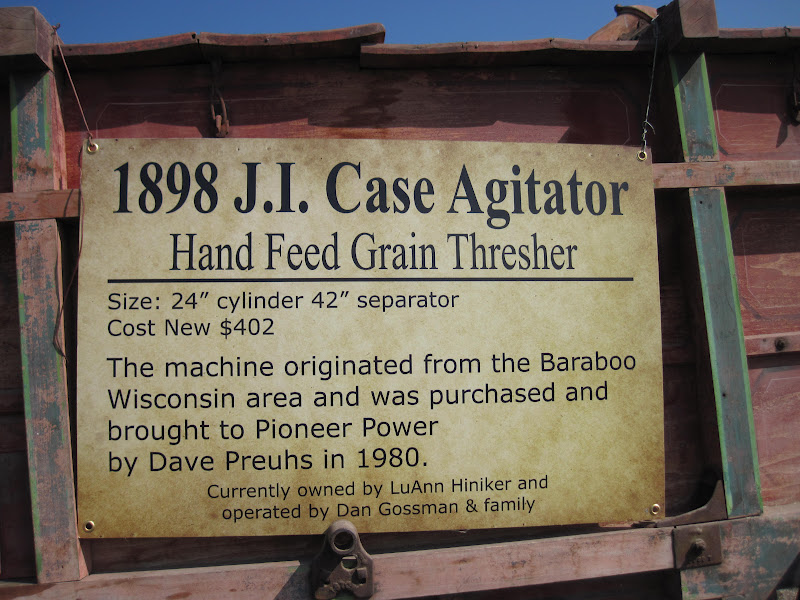
Many threshers were running simultaneously during part of the day, but one that had particular interest for me was the 1898 Case. The sign below gives its history and present situation.

When this machine came out, it provided the latest in threshing technology, which is why I want to use it as an example in my book because it lacks a number of labor saving devices that were common on the newer machines.
Profile of the 1898 J.I. Case Agitator.
Note the short feeder on the left provided a platform where a worker could stand as he cut the twines and fed the stalks into the machine manually. 
On the right, the machine used a conveyor to carry the straw to a pile, which required a man or two to fork the straw away and stack it. Newer thresher had knives that cut the twine, allowing the bundles to be pitched in by a couple of workers, and a blower was used to remove the straw to a pile, eliminating he need for workers to stack it.

Since it lacked knives to cut the twine on the bundles, a man had to cut the twine and hand-feed the stalks into the feeder, which was a slow, dusty process. Pictured above are Shannon Prostrollo pitching and her father Dan Gossman feeding feeding the machine. Dan told me that when he soaks the red bandanna with water and ties it over his nose and mouth as he has done on the photo above, it almost makes the job of hand feeding the machine bearable.

Without someone stacking the straw, as shown below, the straw would pile up and block the flow of straw from the conveyor as shown above.

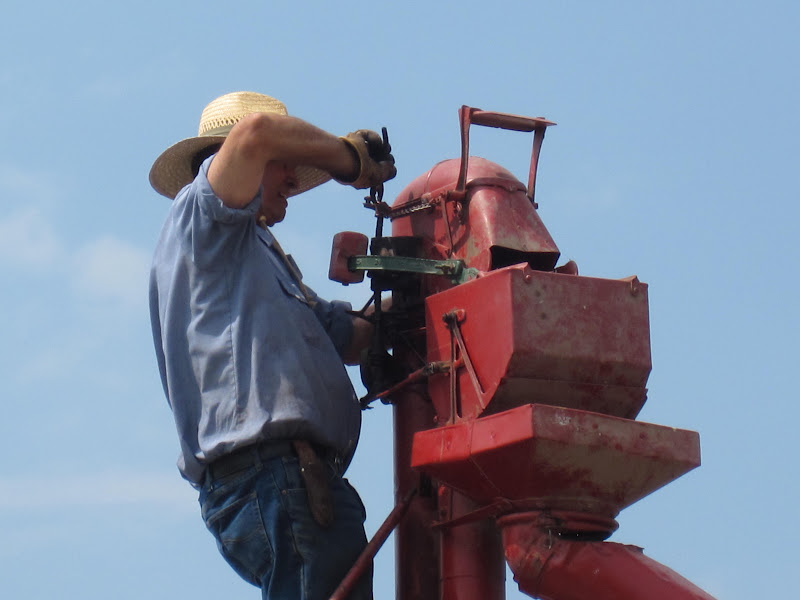
To handle he grain, the 1898 Agitator had a sacker attachment. The handle on the top tallied the number of times the sacker was switched from one side to the other. Farmers were billed by the machine's owner according to the amount of grain threshed.

The 1898 machine is powered by horses in a nearby building. As the horses walk in a circle, their muscles turn gears that transmit power to a shaft running along the ground.
The shaft transmits power to a pulley near the 1898 Agitator, and the pulley is connected by a belt to power the threshing machine. as shown below. In the picture below, while the horses are ready to perform their tasks in the shed in he background, the men belt up the drive pulley.

The handle on the transfer box in the above photo engages the horse's power to the pulley.


Left to right are Shannon Prostrollo, Shannon's son Josh, Scott Gossman, Dan Gossman, LuAnn Hiniker, and Larry Leckband.
Dan Gossman and his family are the operators. Scott is Dan's brother and Shannon is Dan's daughter.
Larry is from Ocheyedan, Iowa, and was introduced to me as "a wealth of information," an inventor, and a collector of antiques.
LuAnn is the proud owner of the 1898 Case Agitator. 
Thanks to LuAnn and the Gossman Family for maintaining and operating the machine.

Nancy and my interests in this machine started when Shannon stopped by our booth earlier to chat and invite Nancy and me down to the demonstration for photo opportunities.  Thank you, Shannon.

This machine is over 110 years old and reflects great care in its history. The paint is faded but clearly visible, and the mechanical parts work fine. We are all thankful for the people who take the time, make the effort, and pay the expenses to operate the many antique pieces of equipment that keep our farm heritage alive. 


In stark contrast to the 1898 J.I. Case Agitator is the newer and larger model Case thresher with two wing feeders, a straw blower, and grain auger shown below.


Powering the big Case Machine is a tractor made by the Minneapolis Threshing Machine Company.
The large wing feeders allowed bundles to be pitched from wagons from both sides simultaneously, and when it was used for stack threshing, it enabled close proximity of the machine to several stacks without moving the machine, which was a time-consuming process.
The above close-up shows the bundles coming into the main feeder from both sides.
Straw is evacuated by a large blower and the grain is dispersed into a grain box with an auger, eliminating the need for workers to tend the sacker and the conveyor as on the 1898 Agitator.

But nothing is so perfect that it wouldn't need a bit of fixing from time to time, as shown in the photo below.
 Instead of the machine counting sacks as the 1898 Case Agitator, this machine actually weighs the oats and counts the number of bushels. The weight of the oats in the hopper is dumped into the auger when it exceeds the set weight of half a bushel as set by the counterweight.

There are lots of activities going on at the same time during the three-day event, and to answer all types of questions, the organization has an information booth, which was tended by our good friend, Betty Sticha, an active and long-time member of the club pictured in the information booth below:


Officer and Board Member, Harold Wondra was in charge of Preuhs Building where we exhibited, and in the photo below, Harold takes time in his busy day to pose as he drives the grounds to provide help to customers and workers during the three-day event.

Harold's wife Ellen watches the 25-minute photo display in our booth. She is a long-time friend of ours, and we were glad to discover she enjoyed the photos.

Customers and visitors kept us pretty busy, but during the two-hour parade of tractors, Nancy managed to snap a photo of our friend Dick Mushitz driving a Massey Harris that he restored.

Nancy and I had a great time exhibiting our photos and selling our books at the 39th annual LeSueur County Pioneer Power Show, but three days wasn't enough for us to get away to see the many other exhibits. However, if you put the third weekend after the first full week in August on your calendar for 2013, you could try to cover it all yourself. Stop in to say hello to us if you do. Go to their website at www.pioneerpowershow.com for more information.

Thanks to Harold Wondra for contacting us to exhibit and thanks to all of the hard-working members of  the club for making it all possible. Also, special thanks to Doug Hager for his time and expertise and to Shannon Prostrollo for reaching out to us to let us know about the amazing 1898 J.I. Case Agitator.
Hope to see you all again next year.

Photographs by Nancy A. Fredrickson


Saturday, June 16, 2012

Fox Out Front

I'm used to getting a glimpse of the elusive fox once or twice during a summer, but recently I've surprised the animal far more times than I have during my entire life.
Last week, I heard the wrens making even more noise than they usually do, so I ventured over to the wren house to see if there was an issue. I thought heard a slight growl. Figuring a neighbor's dog might be in the brush, I clapped my hands. Then I saw a fox tail slip behind the arborvitae. Obviously, I had no camera, but after the fact, I took some pictures of the area.
 Imagine, if you would, playing hide and seek with a fox among these arborvitaes. The pyramidal arborvitaes on the left are about 15 feet tall and 4 feet wide. The global arborvitaes on the right are about 10 feet tall and 8 feet wide. The fox outsmarted me for several minutes before I saw the tail gliding away over the hill about 40 feet away. This whole array of greenery is less than 50 feet from our house, an unusually close distance for a fox to visit for very long.

The next morning as Nancy and I were about to venture out to look at the flowers, she stopped and ran for the camera, exclaiming, "Fox!"
Fox was less than 10 feet from the house, looking for some bug protein among the rocks. Looks pretty thin, huh? Maybe Fox might actually be raising offspring in the nearby juniper bushes which are only about 30 feet from the house.

 I know this is unlikely as heck,  but why else do we keep seeing him so close to the house? Why is he so reluctant to leave? Why else do the wrens make even more noise than usual? Why did the cedar waxwings that nested in the junipers this spring, leave after a short time?  Eight to ten cedar waxwings usually nest in the low junipers and entertain us all summer and into the fall, but their nest in the low junipers could easily be reached and robbed  by Fox.
Fox posing by mugo pine, near the junipers, about 12 feet from the house.
Could the low junipers (center) conceal the den of Fox?
The wrens have taken over one of my bluebird houses, and you can see in the photo above the close proximity of the house to the low junipers. I know it's pretty unlikely that Fox will raise young this close to humans, but he keeps appearing almost daily and doesn't seem all that frightened of us. Of course, we've done nothing to scare him, unless you count the clapping I did when I thought his growl was a neighbor's dog.

Well, it's fun to speculate, and we'll be watching to see what happens. I'll let you know.

Photographs by Nancy A. Fredrickson


Sunday, April 8, 2012

A visit with Illustrator Robert Williams

Since January Bob Williams from Vernon Center, Minnesota, has been working on sketches for my new book, A Farm Country Harvest, which I hope to publish with Beaver's pond Press in 2013. Nancy and I visited Bob in November of last year to discuss the project and he agreed to create 36 illustrations according to the text, photographs, and sketches I sent him.
After we delivered the packet of drawings and photographs to him in January, he began sketching each illustration on a piece of wooden slate measuring ten inches wide and eight inches high.
We swapped emails regularly as he would send me a copy of each sketch to discuss and I would send it back with comments. In March he completed all 36 sketches, each exceeding my expectations.

I collected the email attachments of Bob's 36 sketches on the long tables in our library at home. I like to lay them all out side by side so I can check for continuity from one illustration to the next.


Bob told me he planned to paint them in groups of six, selecting non-sequential pages that had similar characters and scenes. Recently, he contacted me to say he had completed six illustrations, and we agreed Nancy and I should visit him to ensure that we concurred on the results.
When Nancy and I visited Bob's studio last Wednesday, we were delighted to view six completed illustrations for our book, A Farm Country Harvest. 

 Before painting the detail, he covered the entire surface with a gold harvest color that gives the finished product the bright, earthy color of harvest in hot August.

Above, Bob works on the next six illustrations, and below, you can see the golden color that covers the details of the sketch on those painting on the right. Bob has painted some of the detail on the paintings on the left. 


Bob is a generous with his time and his art. He willingly explains his techniques and takes time to show us many of his other paintings.

\
His studio is populated with finished works and some works in progress.


Bob and his wife Anne enjoy the many artworks that Bob has created and hung throughout their house.
He also paints some artwork directly onto the walls in the living room and kitchen.

 Bob Williams with some of his art.

Bob shows us his sketchbook, above, and we see that the sketches below reflect the fact that his first job as an artist was working for Josten's, a company that provides plaques, awards, rings, etc. for schools.

He encourages young artists to keep a sketchbook and draw, draw, draw.
He says, "Prospective employers are often more interested in seeing your sketchbook than they are in seeing your finished paintings. Sketchbooks show your thinking. And drawing is thinking."


Bob expects to finish the illustrations for my book,  A Farm Country Harvest, in three months or less.
So you might ask, "Why is the book not going to be ready until next year?" 
Well, Bob's illustrations are intended to help tell the fictional story of what happens when the threshing machine arrives at the Carlson Family Farm in 1950, but because the word "harvest" or "threshing" brings to mind so many various images to people, the last half of the book will contain a narrative accompanied by actual photographs of harvest activities. 

To gather these pictures, Nancy has been sending out emails to museums, historical societies, and individuals requesting harvest pictures from the 1940s and early 1950s. She has been organizing them, and we plan to select which photos to use some time this summer or fall. Then I will write the narrative as Nancy assembles and identifies the photographs.

A Farm Country Harvest will be a unique attempt at telling the harvest story. The fictional account of the Carlson Family will be in fun meter and rhyme as others in the Farm Country Tales series, and the book will attempt to tell an entertaining, universal story of the activities on a family farm when the threshing machine arrives in 1950. Activities will be accurately represented and the story is based on actual events.

The second half of the book will trace harvest activity with pictures submitted by people from all over the Midwest and other parts of the United States. I hope the combination of a story with illustrations and a narrative with actual photos will help make the book personal, entertaining, authentic, and memorable to readers. I want it to be a book that will be set out on special spot in people's houses and be picked up often to be paged through for its illustrations, its photographs, and its story, a story that people can embrace as their story or the story of their parents, grandparents, or great grandparents.

Do you have some photos to submit? Here is an opportunity to get your family harvest photo into a collector series of books. We are looking for all kinds of farm photos so give us a call. My next book will be about filling silo with bundles and a silage cutter so if you have any silo-filling pictures, let us know. 
Nancy will contact you before we use the photo, and if we use a photo that you submit, we will give you a free book.

To contact Nancy or me to submit photos, call 952-461-2111 or click here to email.