Nancy and I were planning to attend the three-day event for one day to take photos for our new book, A Farm Country Harvest, but when officer and board member, Harold Wondra called me a few weeks before the show to ask us to exhibit, Nancy and I were glad to accept the offer. We saw it as a great opportunity to offer our books for sale and show the many photographs of farm activities that we've collected from museums and farm families from all over Minnesota and other states.

People of all ages seem to enjoy looking at the collection of farm activity photos.


 Loren Riebel with his dairy equipment collection.


When this machine came out, it provided the latest in threshing technology, which is why I want to use it as an example in my book because it lacks a number of labor saving devices that were common on the newer machines.


Nancy poses in our exhibit of farm photos and my books.
On the small TV on the left, all eight of my books run with pages showing at 3-second intervals.
On the large TV in the center, photos of farm activities run with pages showing at 3-second intervals.
The farm photo display on the TV lasts for about 25 minutes and often people would take turns to sit on the one chair to watch the entire display unfold.

To the left of our booth, Dorothy Riebel, board member and officer of Pioneer Power, dawns her house dress and apron to demonstrate washing and ironing as it was during the era before automatics.
Dorothy's husband Bob is also an active member of the organization.

Across the aisle from us, Carl and Joan Veldhuizen exhibit Carl's working scale-models of antique equipment and Joan's crocheting. Joan offers for sale many of the items she makes.
To the right of our booth, Loren Riebel displays part of his vast collection of antique farm tools, which he labels with a number, and the "key" is posted on a sheet nearby so after viewers quiz themselves on naming the tools, they can check their answers. Sorry, but we did not get a photo of Loren's fabulous display, but he displays every year. Stop by next year to see it. You will not be disappointed.
Loren's children and grandchildren showed up later to have photos taken with him(We missed the photo op because we were busy.), but the great thing is that so many of the younger generation in his family are very interested in his tool collection. Gaining and maintaining the interest of the young people is absolutely necessary for farm heritage to be passed on.
When things slowed down for us, Nancy went over to the Creamery Building where Loren displays his dairy equipment collection.


As you can tell by the grins on the faces of Dorothy, Carl, Joan, and Loren, they enjoy what they do, which seems to be the case for all of the hard-working members who keep things going at LeSueur County Pioneer Power Show.
We did not get time to look at all the activities and displays (not even close), but we did focus on the ones that provided opportunities for photos that we can use in our book, A Farm Country Harvest, which we hope to release by summer of 2013.
After asking around, we discover that if we need information on threshing machines and the names of the operators, the guy to talk to is Doug Hager, who has the amazing responsibility of being in charge of maintaining and operating the threshing equipment.

Doug Hager, taking a moment to talk with me about his work.
The many activities of the day keep Doug really busy, and as he hustled about his work with confidence, he was always willing to answer questions from observers. I expected he might be too busy to talk to me about asking him for help with my book, but he seemed eager to help in any way. This is the way it is at the Pioneer Power Show.

I was clever enough to stay out of Doug's way when he was operating or fixing the machines.

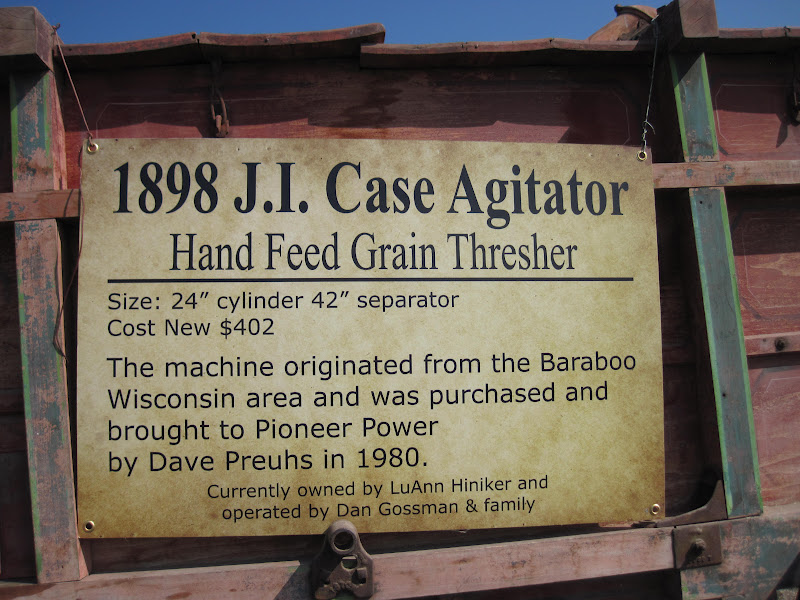
Many threshers were running simultaneously during part of the day, but one that had particular interest for me was the 1898 Case. The sign below gives its history and present situation.

Profile of the 1898 J.I. Case Agitator.
Note the short feeder on the left provided a platform where a worker could stand as he cut the twines and fed the stalks into the machine manually.
On the right, the machine used a conveyor to carry the straw to a pile, which required a man or two to fork the straw away and stack it. Newer thresher had knives that cut the twine, allowing the bundles to be pitched in by a couple of workers, and a blower was used to remove the straw to a pile, eliminating he need for workers to stack it.

Since it lacked knives to cut the twine on the bundles, a man had to cut the twine and hand-feed the stalks into the feeder, which was a slow, dusty process. Pictured above are Shannon Prostrollo pitching and her father Dan Gossman feeding feeding the machine. Dan told me that when he soaks the red bandanna with water and ties it over his nose and mouth as he has done on the photo above, it almost makes the job of hand feeding the machine bearable.

Without someone stacking the straw, as shown below, the straw would pile up and block the flow of straw from the conveyor as shown above.


To handle he grain, the 1898 Agitator had a sacker attachment. The handle on the top tallied the number of times the sacker was switched from one side to the other. Farmers were billed by the machine's owner according to the amount of grain threshed.
The 1898 machine is powered by horses in a nearby building. As the horses walk in a circle, their muscles turn gears that transmit power to a shaft running along the ground.

The shaft transmits power to a pulley near the 1898 Agitator, and the pulley is connected by a belt to power the threshing machine. as shown below. In the picture below, while the horses are ready to perform their tasks in the shed in he background, the men belt up the drive pulley.


The handle on the transfer box in the above photo engages the horse's power to the pulley.

Left to right are Shannon Prostrollo, Shannon's son Josh, Scott Gossman, Dan Gossman, LuAnn Hiniker, and Larry Leckband.
Dan Gossman and his family are the operators. Scott is Dan's brother and Shannon is Dan's daughter.
Larry is from Ocheyedan, Iowa, and was introduced to me as "a wealth of information," an inventor, and a collector of antiques.
LuAnn is the proud owner of the 1898 Case Agitator.
Thanks to LuAnn and the Gossman Family for maintaining and operating the machine.
Nancy and my interests in this machine started when Shannon stopped by our booth earlier to chat and invite Nancy and me down to the demonstration for photo opportunities. Thank you, Shannon.
This machine is over 110 years old and reflects great care in its history. The paint is faded but clearly visible, and the mechanical parts work fine. We are all thankful for the people who take the time, make the effort, and pay the expenses to operate the many antique pieces of equipment that keep our farm heritage alive.
In stark contrast to the 1898 J.I. Case Agitator is the newer and larger model Case thresher with two wing feeders, a straw blower, and grain auger shown below.

Powering the big Case Machine is a tractor made by the Minneapolis Threshing Machine Company.

The large wing feeders allowed bundles to be pitched from wagons from both sides simultaneously, and when it was used for stack threshing, it enabled close proximity of the machine to several stacks without moving the machine, which was a time-consuming process.

The above close-up shows the bundles coming into the main feeder from both sides.

Straw is evacuated by a large blower and the grain is dispersed into a grain box with an auger, eliminating the need for workers to tend the sacker and the conveyor as on the 1898 Agitator.
But nothing is so perfect that it wouldn't need a bit of fixing from time to time, as shown in the photo below.
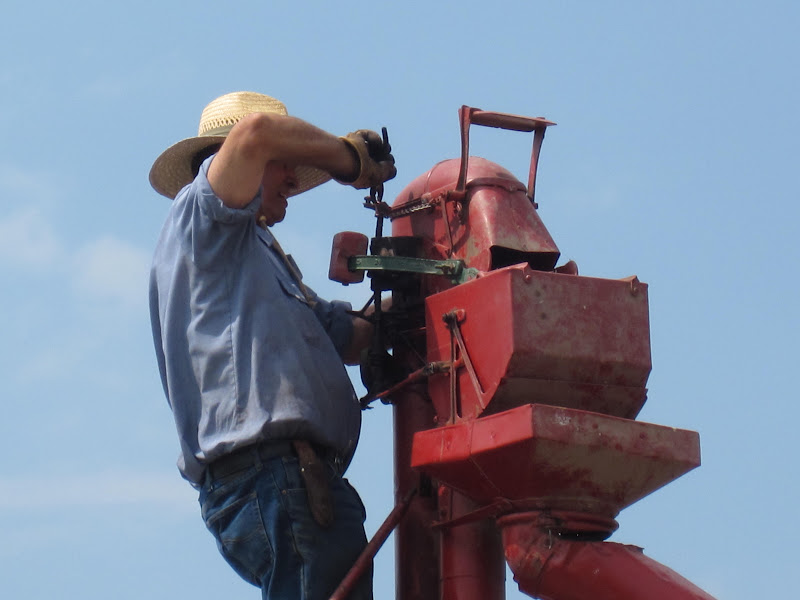
Instead of the machine counting sacks as the 1898 Case Agitator, this machine actually weighs the oats and counts the number of bushels. The weight of the oats in the hopper is dumped into the auger when it exceeds the set weight of half a bushel as set by the counterweight.
There are lots of activities going on at the same time during the three-day event, and to answer all types of questions, the organization has an information booth, which was tended by our good friend, Betty Sticha, an active and long-time member of the club pictured in the information booth below:

Officer and Board Member, Harold Wondra was in charge of Preuhs Building where we exhibited, and in the photo below, Harold takes time in his busy day to pose as he drives the grounds to provide help to customers and workers during the three-day event.


Harold's wife Ellen watches the 25-minute photo display in our booth. She is a long-time friend of ours, and we were glad to discover she enjoyed the photos.

Customers and visitors kept us pretty busy, but during the two-hour parade of tractors, Nancy managed to snap a photo of our friend Dick Mushitz driving a Massey Harris that he restored.
Nancy and I had a great time exhibiting our photos and selling our books at the 39th annual LeSueur County Pioneer Power Show, but three days wasn't enough for us to get away to see the many other exhibits. However, if you put the third weekend after the first full week in August on your calendar for 2013, you could try to cover it all yourself. Stop in to say hello to us if you do. Go to their website at www.pioneerpowershow.com for more information.
Thanks to Harold Wondra for contacting us to exhibit and thanks to all of the hard-working members of the club for making it all possible. Also, special thanks to Doug Hager for his time and expertise and to Shannon Prostrollo for reaching out to us to let us know about the amazing 1898 J.I. Case Agitator.
Hope to see you all again next year.
Photographs by Nancy A. Fredrickson


