Friday, June 22, 2012

Elmore Public Library

The town of Elmore is located on Highway 169 about as far south in Minnesota as you can get. Customers in the library said that  if I'd missed the turn to the library and gone south two more blocks, I would've been in Iowa. 
The town is proud of their new library, and I agree that it is a very nice facility. However, since it sprinkled or rained during the entire two and a half hours we were there on Wednesday, Nancy could not get a picture of the front of the building.

She did get a photo of the rain through the glass doors that exit out the back of the conference room where I did my Farm Heritage Program.

When we came to set up, a group of people were having coffee in the conference room. They made us feel especially welcome because they credited us with bringing the rain. It was the first rain they had in weeks and the area was really dry. They left while we set up, but the picture below shows that they kept their promise to return for my program.


We were expecting a group of small children, which is why I chose to do a program that included my book, If I Were a Farmer: Nancy's Adventure, but the rain probably kept them from riding their bikes or walking to the library. The older folks seemed to enjoy the show, though, and were kind with their comments and also purchased a number of books.

Everyone took time before or after the program to view and comment on Nancy's display of farm heritage photographs that we are preparing for our new book, A Farm Country Harvest.

Nancy and I wish to thank the librarian, Nancy Ziegler, for calling and inviting us to do our Farm Heritage Program at the Elmore Library. I also want to thank all the board members, especially Doris and Audrey, for taking time to chat and helping to arrange my visit. A special thanks to Doris Klein, who remembered me from when I did a show at Frost Library in 2010 and recommended my visit to Elmore. She kindly told me that she had purchased A Farm Country Christmas Eve after the show at Frost and brings it out to read at Christmas time.

Photographs by Nancy A. Fredrickson


Thursday, June 21, 2012

Fox Follow-up

Nancy and I experienced over a week where we had an unusually high number of fox-sightings, where the animals were very close to us and our house. Although its den was elsewhere, we saw fox many times throughout the day. This was an exciting and uncommon experience, but it had its sad side too, which I'll explain later. But first, a few photos.
The photo above is closely cropped so it may seem a bit blurry, but I wanted to point out the differences in color between this one and the other one. Yes, there are at least two fox, and though there may be more than two, I think we have been seeing only two different ones.
 The one above appears older and healthier. Note the black shading on the back. I cannot tell from this angle if it a male fox or a female, which is called a vixen. 


The fox below is clearly smaller and quite mangy-looking. It could be a young one. During mid-day on Tuesday, I surprised the smaller fox as it was curled up inside a five-gallon pail that was tipped on its side by the garden. It scrambled out and ran, stopping after about fifty yards to look back at me in that unique, fox-like manner. 
Five minutes later while I was still roaming the yard, I saw the larger fox return, trot up to the pail, and look inside. Seeing nothing, it quickly gazed around for danger before it ran off. It looked pretty surprised that the little fox was gone. Later I smelled the inside of that pail. It was really a strong odor! I'd guess the smaller fox napped in there often.


The next day we saw no fox, and we haven't seen them since, which led Nancy and me to speculate why.
The answer, I think, is obvious now. Our house and yard provided an easy food source for a short time.

In May and early June I noticed that there were no rabbits around. Last year they were all over the yard. Apparently, the fox made short work of them last winter and this spring. Then this spring we experienced lots of robins hopping on the ground in the back yard, and they seemed more tame and unaware than usual. I remember that Nancy and I commented on the plentiful robin population every day we saw them. There aren't as many tame ones around now. We also had cedar waxwings in the junipers, wrens that would complain with only common, wren-like regularity, and lots of brave chipping sparrows that would hop near our feet when we sat on the porch. When the fox were around the waxwings left, the wrens became very noisy, and for awhile the chipping sparrows became more shy.

The sad side of the fox-sightings is that the fox hunted the rabbits, robins, low-nesting waxwings and chipping sparrows very aggressively until the "easy pickings" were gone. Now they have moved on.
Well, I'm not sad about the rabbits being gone, and the surviving waxwings may return again. The wrens are undamaged, and because the fox are not around, they complain less. Chipping sparrows are back hopping near our feet again. I think their nests were higher in the arborvitae. However, I was really sad to see a number of scattered robin feathers where the fox had been successful. I counted five.

Well, the fox were just trying to make a living, and I certainly do not begrudge a wild animal that right. They live a hard, unforgiving life. If they don't make a kill, they will die.
I do, however, continue to chase away well-fed house cats from our yard because they do not need the birds for food or live toys. I wouldn't hurt any kitties, but I prefer they lead their semi-civilized lives in their own yards.

Photographs by Nancy A. Fredrickson

Saturday, June 16, 2012

Fox Out Front

I'm used to getting a glimpse of the elusive fox once or twice during a summer, but recently I've surprised the animal far more times than I have during my entire life.
Last week, I heard the wrens making even more noise than they usually do, so I ventured over to the wren house to see if there was an issue. I thought heard a slight growl. Figuring a neighbor's dog might be in the brush, I clapped my hands. Then I saw a fox tail slip behind the arborvitae. Obviously, I had no camera, but after the fact, I took some pictures of the area.
 Imagine, if you would, playing hide and seek with a fox among these arborvitaes. The pyramidal arborvitaes on the left are about 15 feet tall and 4 feet wide. The global arborvitaes on the right are about 10 feet tall and 8 feet wide. The fox outsmarted me for several minutes before I saw the tail gliding away over the hill about 40 feet away. This whole array of greenery is less than 50 feet from our house, an unusually close distance for a fox to visit for very long.

The next morning as Nancy and I were about to venture out to look at the flowers, she stopped and ran for the camera, exclaiming, "Fox!"
Fox was less than 10 feet from the house, looking for some bug protein among the rocks. Looks pretty thin, huh? Maybe Fox might actually be raising offspring in the nearby juniper bushes which are only about 30 feet from the house.

 I know this is unlikely as heck,  but why else do we keep seeing him so close to the house? Why is he so reluctant to leave? Why else do the wrens make even more noise than usual? Why did the cedar waxwings that nested in the junipers this spring, leave after a short time?  Eight to ten cedar waxwings usually nest in the low junipers and entertain us all summer and into the fall, but their nest in the low junipers could easily be reached and robbed  by Fox.
Fox posing by mugo pine, near the junipers, about 12 feet from the house.
Could the low junipers (center) conceal the den of Fox?
The wrens have taken over one of my bluebird houses, and you can see in the photo above the close proximity of the house to the low junipers. I know it's pretty unlikely that Fox will raise young this close to humans, but he keeps appearing almost daily and doesn't seem all that frightened of us. Of course, we've done nothing to scare him, unless you count the clapping I did when I thought his growl was a neighbor's dog.

Well, it's fun to speculate, and we'll be watching to see what happens. I'll let you know.

Photographs by Nancy A. Fredrickson


Friday, June 15, 2012

History Center of Olmsted County

The History Center of Olmsted County in Rochester, Minnesota, is an impressive building, especially with a tractor parked in front of it. But that isn't all that charmed me about the place.

I'm really partial to being greeted by someone with an energetic, genuine smile, and Janet Timmerman, who arranged my visit, was at the door to do just that as we entered the building. Janet showed us around the historic center and introduced us to a few of the hard-working staff members.
The audience for my Farm Heritage Program was small,  but it included one of the sweetest four-year-old girls on the planet, and I could see she enjoyed my story, If I Were a Farmer: Nancy's Adventure.
And her mother bought a couple of books, too.

Also in the audience were staff members who will be reading my books to children in the upcoming weeks. Since my goal is to get my books out to adults and children, I was really gratified to have the History Center purchase my books for this purpose.

I thank Janet Timmerman for inviting me to perform at the History Center of Olmsted County and for arranging my visit. I hope she invites us back soon.

The History Center has many great displays inside the building, and to tour the outdoor displays, customers can ride on the wagon pulled by the tractor parked out front. Visit the History Center with the whole family.

Photographs by Nancy A. Fredrickson.


Thursday, June 14, 2012

Risen Savior Seniors

Risen Savior Seniors is a small group that meets at the Risen Savior Church off Dakota County Road 42, which is only a few miles from my place. When Geneva (Speiker) Meives, a long-time friend from the Farm Country Neighborhood where I grew up, asked me to do my Farm Heritage Show for the group, I was delighted to comply. They provided a nice big room, a big pull-down screen, a friendly audience, and a pot-luck lunch. It can't get any better than that!
After mass, a short  business meeting, and lunch, Geneva gave me a better introduction than I deserved before I started my 35-minute show.
Before and after the show, group members checked out the farm photos we had on display and my books, which we had for sale at a reduced "Event" price. 
The photos are farm photos from the early to the middle of the last century which have been submitted by farmers and former farm-kids from throughout the Midwest in response to our request for harvest photos and other farm photos to put in our upcoming books.
Geneva and her husband Everett pose for a picture with me after the show.

I want to thank the Risen Savior Seniors for inviting me to speak, especially Geneva, who arranged the event, and Connie, who helped organize my setup. We also thank all of those people who bought books, shared their stories with me, or had kind words for me after the program. Nancy and I had a fun time and we hope you did too.

Photographs by Nancy A. Fredrickson


Friday, June 8, 2012

What a leaf!

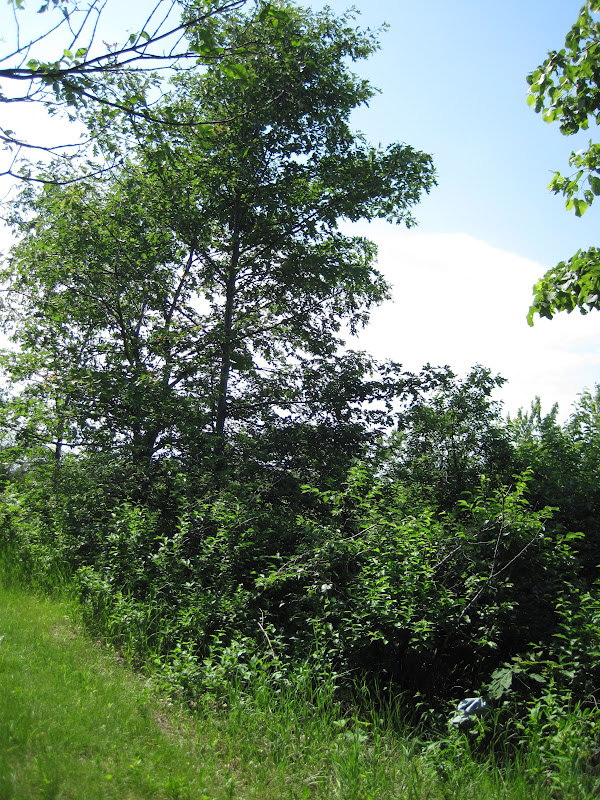
An oak leaf the size of a man's hand is fairly standard, but take a look at this one I found on a young tree which stood less than knee high in the small woods by our house.

 The leaf is nearly 12 inches long and 10 inches wide.


I spotted the leaf in the undergrowth near a red oak, which we planted less than 20 years ago and is the proud parent of this struggling young tree. The little tree has grown from an acorn and poked its way through the tall grass and other greenery to finally rise above all the competition for light.
Producing this huge leaf will ensure that the plant will take in all the light possible to grow taller and build a strong root system.

For a size comparison, I placed my cap on a stiff plum succor so the oak leaf is directly above the cap.

You can see my cap next to the young tree in the lower right corner. The tall, slim parent tree is left of center in the above picture. If the young tree wins the battle to overcome the shade of tight underbrush (peer competition by size), it will face trying to grow up in the shadow of its parent, which by that time will be spreading widely, blocking the sun with its broad, thick leaves.

The young tree's goal is to survive, and to survive it has to physically overcome the parent tree.  The conflict will endure throughout the lives of both trees. 

And you think you've had conflicts with your parents! 

Sunday, June 3, 2012

Pruning Apple Trees

This is not a "how to" essay on pruning apple trees. Folks know me as a humble man, claiming no expertise in any area. Indeed, my wife often reminds me that I have much about which to be humble.

When it comes to pruning apple trees, I think I am probably one of the many people who like apple trees and struggle with the question, "How much do I cut off."

First, let me quickly add that I make no attempt to prune my full-sized apple trees. I like to see them get really big, and then I harvest whatever apples they produce. Last summer was a bumper crop, and their limps were so thick with fruit that many of the branches broke. I was eating our apples till the end of February. We were able to pick less than half of the apples, and much of the fruit was left on the trees for the birds or knocked to the ground for the deer.
I was too busy picking apples to take a picture of the trees with fruit on them last fall, but here is a photograph of the three Haralson trees as they look now.
Lowest branches on these trees are about six feet from the ground. The top ten feet on the tree in the foreground is beyond what I can reach, even if I stand in the bucket of the front-end loader on my tractor.

But I like to try to prune my dwarf apple trees, and I've learned that on dwarf trees, you want to cut off vertical branches and encourage branches to grow horizontally.

Last spring Nancy and I stopped for our monthly shopping at Cedar Summit Farm, north of New Prague, where we buy grass-fed beef, eggs from free-range chickens, honey produced locally, and dairy products made on the premises. Check out their website. www.cedarsummit.com
We caught a quick conversation with owner Dave Minar, and since I know he is a man of many talents and much wisdom, I asked him about pruning apple trees.
He said, "Well, you want to cut off enough branches so that you can take the meanest and biggest tomcat on the farm and toss him through the middle of the tree."
THIS IS A HYPOTHETICAL TOSS!
Don't try this at home, Folks. Don't actually toss the cat. We all love kitties. This is just meant as something to imagine.
So if you can imagine what a tree might look like if you could indeed toss a big tomcat through it, you may come up with a tree resembling mine after I took Dave's advice.
I took these pictures today. I didn't have the courage to take a picture of what they looked like immediately after I pruned them this spring when the branches were bare.

If you line the trees up just right, I think you could get the cat through both trees with one good, strong toss.

The trees have lots of fruit and look like they are doing fine even after I butchered them.

If you want expert advice on pruning, I suggest contacting the University of Minnesota Extension. 
Also, I wouldn't mention the tomcat test.