Showing posts with label flowers. Show all posts

Tuesday, June 14, 2011

Deer damage again and popping poppy, II

A few days ago Nancy and I planted a small apple tree that we thought was tall enough to resist deer damage on the top branches. We were wrong.
The tree was well over eight feet tall before the deer broke off the top piece.

Next, we checked to see how the buds on the roses were coming and discovered mama deer had eaten those off as well. I find it remarkable that such a large animal messes with trying to fill up on the buds of roses. On the other hand, humans eat marsh mellows, hard candy, and potato chips because we want to, not because it's practical. 

While I pouted a little as I weeded around the rose bush, Nancy commented that she would make more deer repellent and spray it on the roses. I continued to weed after she left.

Then I heard her yell, "Hey, Gord, poppies are popping!"
The flower is beginning to force the green covers off. The process takes about 15 minutes and if you are patient, you can see the movement and the blossom emerge.

Last year ( June 21, 2010, to be precise) I posted a short piece with pictures detailing a poppy blossom popping into full bloom. I was fascinated then and was equally fascinated once again as the birth of the blossom took place before my eyes.

The poppies easily managed to change my pout into a grin. I hope they made you smile.

All photographs by Nancy A. Fredrickson 

To see more flower photos,  please click below on Read More.

Thursday, June 2, 2011

Hummingbird Magnets

Nancy and I like to sit on the porch to watch the birds and listen to their sounds. We don't put up bird feeders, but we plant lots of wildflowers and certain other flowers that attract the little masters of flight. Finches, catbirds, waxwings and other birds like to nest in the tight foliage of the arborvitaes and yews.
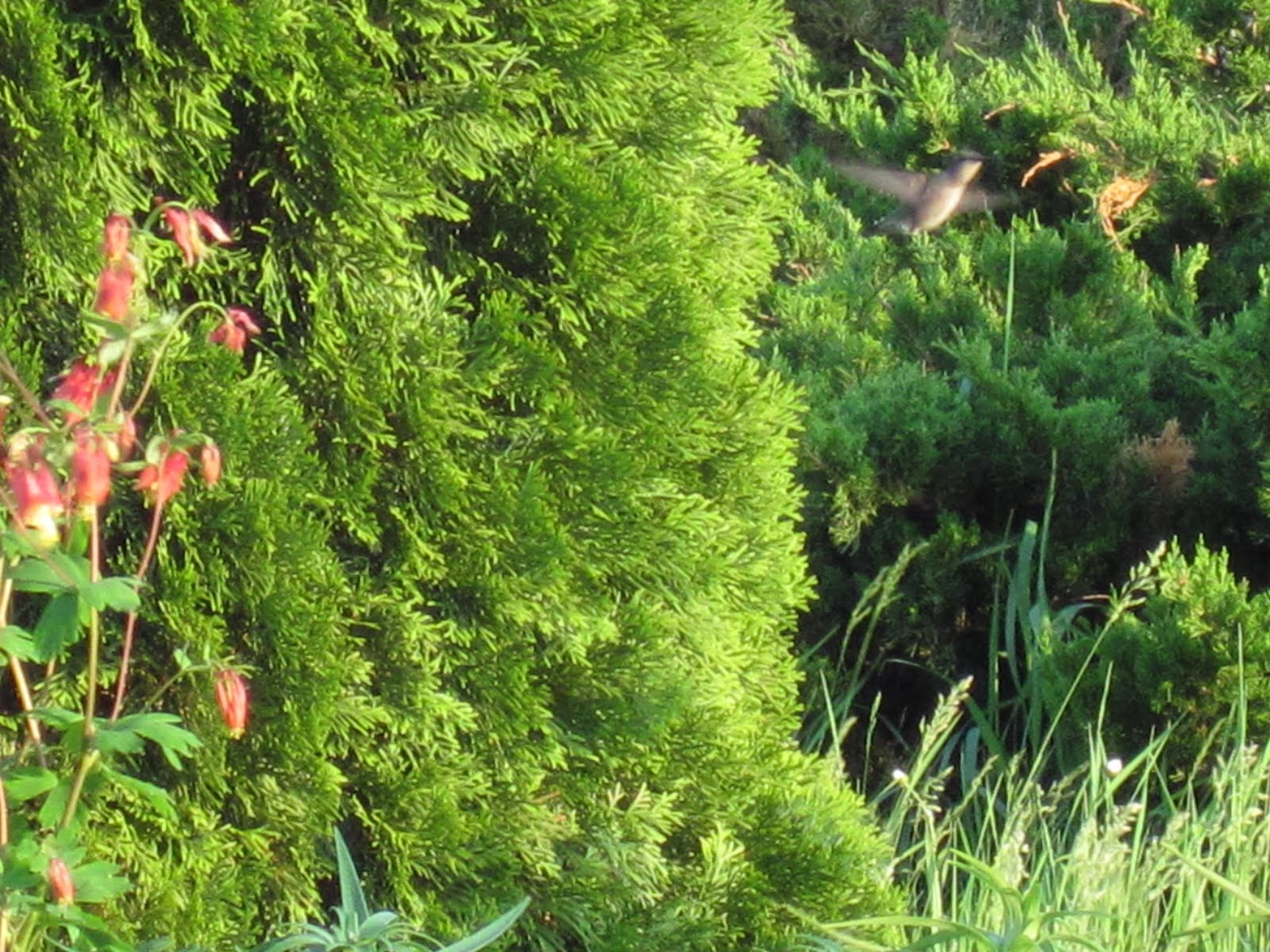
Below is the view from our chairs. About twenty feet away are wild columbines blooming on the left, and near the center are tiger lilies, which will not bloom until summer. Hummingbirds love them both.
In the close-up above, the columbine blossoms appear delicious, 
and in the photo below a hummingbird begins to sample them all.

We had been treated to his visits nearly every evening since the columbines started blooming, 
but this is the first time we had the camera along.
The hummingbird actually seemed to hit every blossom!
Gusts of wind actually gave the little guy a hard time and he had to leave his business of sampling and turn into the wind to stay in control. It didn't delay him more than a few seconds, though, and he returned to his rounds.

After a few minutes of work, he rested briefly on wire cages that we had put up to support top-heavy peonies, day lilies, and white lilies when they bloom in summer. The hard-working master of flight seems to think we put the cages there just for him. I'm glad he takes advantage of the spot to rest.
Then he goes back to work.

After a few more minutes of work, he leaves and as he flies away, another hummingbird flies in to take his place. Is this his mate? The color seemed a bit different, but this one did not stay long and they didn't stop to talk to each other when they passed. Maybe they were married.

Photographs by my dear wife Nancy Fredrickson


Tuesday, May 31, 2011

Lilacs

Close-up of Old-Fashioned Lilac
If you grew up lovin' lilacs like I did, you never quite get over it. My folks moved onto the farm I grew up on in 1940, but they were lucky because sometime around 1910, lilacs had been planted near the house and the hearty plants flourished.

To get the right image though, you have to envision a yard that had never seen the blade of a lawn mower. The grass was knee high on an adult and tall enough for kids to play hide and seek in the twilight hours of the evening. In certain areas where the dandelions were thick, our flock of geese kept the grass down, but they left too many pods behind, making those areas undesirable places to play.

The one civilized area in the yard was the area around the lilac bushes. Mom was proud of this area and proclaimed it as a model for civilization. She expressed her desire to expand the lilacs. So after a a hard day's work and evening chores, Dad and I, led by Mom, found ourselves transplanting the succors from the large bush to make a hedge on three sides of the yard, which measured over 200 feet. Although this took many late evening's of work, that was the easy part. Pumping water by hand and carrying water in pails to keep the plants alive for the next two years was a greater challenge. When I asked Mom why she wanted a lilac hedge, she replied, " Some day when we get a lawn mower, we will know where to quit mowing–at the lilac hedge."
How can anyone argue with that?

It was worth every effort. In a few years we were rewarded with tall bushes that blossomed every spring and provided a border for our lawn. Later, after we sold the geese, we had many grand times on Memorial Day weekend, Labor Day weekend, and the Fourth of July celebrating with our relatives and friends on our lilac-bordered lawn.

Before the construction machinery dozed the farmstead, Nancy and I dug out several of Mom's lilacs and planted them at our place, which is a five-acre piece of the farm I grew up on. Needless to say, the hearty plants flourished, and they treat us to beautiful blossoms every spring, rich foliage that provides shelter for birds during the summer, and a thick bush of branches that provides food and shelter to birds in the winter.
A couple of the many chunks of old-fashioned lilacs we transplanted from Mom's hedge.

Photographs by Nancy A. Fredrickson

To see pictures of five other kinds of lilacs click below on Read More.


Sunday, May 22, 2011

Johnny Jump-up (Viola cornuta)

Last winter, I was worried about my little rose garden as I drove the tractor over the bushes to blow snow away from the house. From the chute of the blower flew huge chunks of pine needles and leaves, which I had used to carefully cover the roses last fall. Not a good sign.

This spring, however, the roses seem to be doing all right, but as anyone who grows flowers will tell you, roses often provide worries.

Johnny Jump-ups, on the other hand, provide no worries.
No sooner had spring sprung and the tireless little wildflowers peeked out from between the tiles on my waterway to greet me with their cheerful presence.

They appeared in groups and they appeared as singles.

They appeared in wide spaces and pushed their way through narrow spaces.
They even seem to cling to walls of stone as in the photo below:

How can you not love faces like those in the picture above?

By early summer the waterway near my garage (pictured above) will be solid Johnny Jump- ups. I'm glad, too, because I don't have to coddle them or even care for them. All I have to do is enjoy them.

Internet information on the hearty wildflower says that they are indigenous to the mountains of Spain and France, but they seem right at home wherever they decide to blossom.

As perennials, Johnny Jump-ups return each spring from the same roots, and the clump just keeps getting bigger and more hearty. Although Johnny Jump-ups often appear where they weren't originally wanted, they seem to escape the hatred many people have for other wildflowers that spread rapidly. 

Why not get some seeds soon and try growing them this spring?


Photographs by Nancy A. Fredrickson

Wednesday, June 23, 2010

Wild Gardener

As I walk out to check my roses in the morning, I take along a  small clipper to cut the withering blossoms, which encourages the bush to produce more buds. Although I love to visit my roses, cutting the old blossoms is not a job I relish.

I tell my wife, "It's just not like me to discard a beautiful  living  thing just because its beauty is fading." Nancy just smiles and shakes her head.

Hiding the small cutter behind my back, I approach my favorite pink rose. She blossoms daily and produces buds packed together as tightly as kittens nursing. I position my nose and inhale. Sweet!

But a former beauty sags, her petals starting to fall. Gently, I gather the old blossom in my hand and snip it off below my fingers. I repeat the process on other fading blossoms until I have a handful of petals, which I discard into the nearby tall grass. "Rest in Peace," I say as I scatter the soft remnants.

I walk two steps to see that my small yellow rose has no blossoms. "What happened to you? Yesterday you had a beautiful new blossom."

A bit puzzled, I take a step toward the red rose, which was loaded with blossoms yesterday, but today only the tops of cut stems look up at me. Not a blossom adorns the knee-high stems and no petals are on the ground. What could've happened??

I rush inside to share the news with my wife, who looks out the window to confirm my discovery. "Maybe a deer ate the blossoms," she offers. "I know they eat other flowers."

Later that day, Nancy comes into the shed to see me as I am working on a project. She shows me the display on her digital camera and grins. "I may have found your gardener. I spotted this little guy eating daisy petals before I ran in to get the camera."


Maybe the rose petals were sacrificed for a better purpose. What do you think?


Photographs by Nancy A. Fredrickson

Monday, June 21, 2010

Popping Poppy

      "Come here, quick!" I hear my wife holler from the flower garden. "A poppy is about to pop!"
I stop my hoeing immediately. Although she's explained this process to me before, I've never witnessed it myself so I hurry to her side, forgetting to put down my hoe.

"You won't need the hoe," she whispers and then grins.

Just to get back at her I ask if we really need to whisper, but she points to the poppy and says,
"See the green cap on the fat bud? The blossom will
force that to pop off."

I'm thinking, "Sure, in about a week," but I say nothing. I haven't been married
nearly forty years without
learning anything. I watch as
 Nancy takes a couple pictures.


To see the poppy, we position ourselves close
to the moist mulch surrounding the poppy's 
stiff green stem. Sure enough, in just a minute or so
half of the green cap falls silently to the ground.  
Nancy snaps another picture.

"Wow!" I exclaim, strectching my vocabulary to 
meet the wonder of the moment. 


We share a smile and wait only briefly  before we see the second part of the green cap drop to the ground.
 Nancy repositions herself to snap a picture of both pieces of the green cap on the ground as the flower opens to show its large, delicate petals.
         
              
.
Photos by Nancy A. Fredrickson