Tuesday, September 25, 2012

Le Sueur County Pioneer Power Show 2012

The LeSueur County Pioneer Power Show provides the whole family with exciting farm activities that date back to the Nineteenth Century through the middle of the Twentieth Century. Everything from sawing lumber to threshing and baling with rigs that go back to the 1890s.

Nancy and I were planning to attend the three-day event for one day to take photos for our new book, A Farm Country Harvest, but when officer and board member, Harold Wondra called me a few weeks before the show to ask us to exhibit, Nancy and I were glad to accept the offer. We saw it as a great opportunity to offer our books for sale and show the many photographs of farm activities that we've collected from museums and farm families from all over Minnesota and other states.

People of all ages seem to enjoy looking at the collection of farm activity photos.

Nancy poses in our exhibit of farm photos and my books.
On the small TV on the left, all eight of my books run with pages showing at 3-second intervals.
On the large TV in the center, photos of farm activities run with pages showing at 3-second intervals.
The farm photo display on the TV lasts for about 25 minutes and often people would take turns to sit on the one chair to watch the entire display unfold. 

To the left of our booth, Dorothy Riebel, board member and officer of Pioneer Power, dawns her house dress and apron to demonstrate washing and ironing as it was during the era before automatics.
Dorothy's husband Bob is also an active member of the organization.

Across the aisle from us, Carl and Joan Veldhuizen exhibit Carl's working scale-models of antique equipment and Joan's crocheting. Joan offers for sale many of the items she makes.


To the right of our booth, Loren Riebel displays part of his vast collection of antique farm tools, which he labels with a number, and the "key" is posted on a sheet nearby so after viewers quiz themselves on naming the tools, they can check their answers. Sorry, but we did not get a photo of Loren's fabulous display, but he displays every year. Stop by next year to see it. You will not be disappointed. 

Loren's children and grandchildren showed up later to have photos taken with him(We missed the photo op because we were busy.), but the great thing is that so many of the younger generation in his family are very interested in his tool collection. Gaining and maintaining the interest of the young people is absolutely necessary for farm heritage to be passed on.

When things slowed down for us, Nancy went over to the Creamery Building where Loren displays his dairy equipment collection.
 Loren Riebel with his dairy equipment collection.

As you can tell by the grins on the faces of Dorothy, Carl, Joan, and Loren, they enjoy what they do, which seems to be the case for all of the hard-working members who keep things going at LeSueur County Pioneer Power Show. 
We did not get time to look at all the activities and displays (not even close), but we did focus on the ones that provided opportunities for photos that we can use in our book, A Farm Country Harvest, which we hope to release by summer of 2013.

After asking around, we discover that if we need information on threshing machines and the names of the operators, the guy to talk to is Doug Hager, who has the amazing responsibility of being in charge of maintaining and operating the threshing equipment.
Doug Hager, taking a moment to talk with me about his work.

The many activities of the day keep Doug really busy, and as he hustled about his work with confidence, he was always willing to answer questions from observers. I expected he might be too busy to talk to me about asking him for help with my book, but he seemed eager to help in any way. This is the way it is at the Pioneer Power Show.  
I was clever enough to stay out of Doug's way when he was operating or fixing the machines.

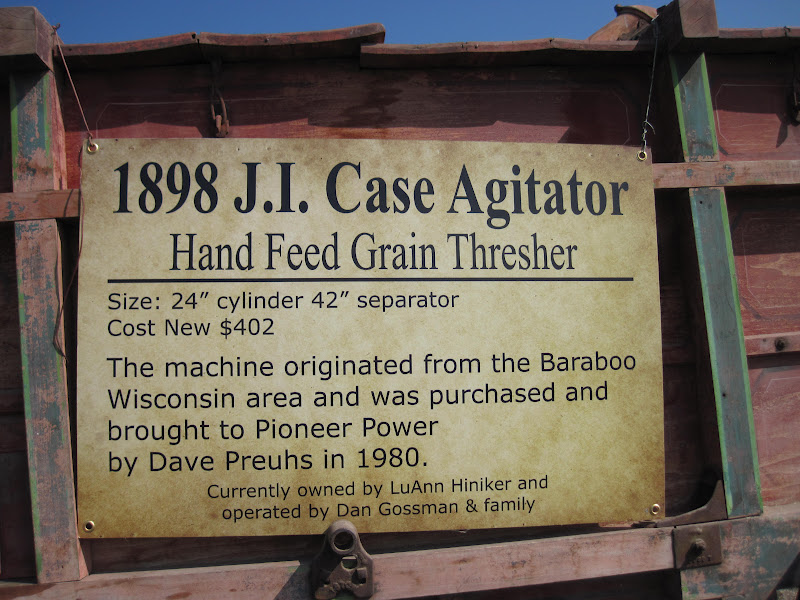
Many threshers were running simultaneously during part of the day, but one that had particular interest for me was the 1898 Case. The sign below gives its history and present situation.

When this machine came out, it provided the latest in threshing technology, which is why I want to use it as an example in my book because it lacks a number of labor saving devices that were common on the newer machines.
Profile of the 1898 J.I. Case Agitator.
Note the short feeder on the left provided a platform where a worker could stand as he cut the twines and fed the stalks into the machine manually. 
On the right, the machine used a conveyor to carry the straw to a pile, which required a man or two to fork the straw away and stack it. Newer thresher had knives that cut the twine, allowing the bundles to be pitched in by a couple of workers, and a blower was used to remove the straw to a pile, eliminating he need for workers to stack it.

Since it lacked knives to cut the twine on the bundles, a man had to cut the twine and hand-feed the stalks into the feeder, which was a slow, dusty process. Pictured above are Shannon Prostrollo pitching and her father Dan Gossman feeding feeding the machine. Dan told me that when he soaks the red bandanna with water and ties it over his nose and mouth as he has done on the photo above, it almost makes the job of hand feeding the machine bearable.

Without someone stacking the straw, as shown below, the straw would pile up and block the flow of straw from the conveyor as shown above.

To handle he grain, the 1898 Agitator had a sacker attachment. The handle on the top tallied the number of times the sacker was switched from one side to the other. Farmers were billed by the machine's owner according to the amount of grain threshed.

The 1898 machine is powered by horses in a nearby building. As the horses walk in a circle, their muscles turn gears that transmit power to a shaft running along the ground.
The shaft transmits power to a pulley near the 1898 Agitator, and the pulley is connected by a belt to power the threshing machine. as shown below. In the picture below, while the horses are ready to perform their tasks in the shed in he background, the men belt up the drive pulley.

The handle on the transfer box in the above photo engages the horse's power to the pulley.


Left to right are Shannon Prostrollo, Shannon's son Josh, Scott Gossman, Dan Gossman, LuAnn Hiniker, and Larry Leckband.
Dan Gossman and his family are the operators. Scott is Dan's brother and Shannon is Dan's daughter.
Larry is from Ocheyedan, Iowa, and was introduced to me as "a wealth of information," an inventor, and a collector of antiques.
LuAnn is the proud owner of the 1898 Case Agitator. 
Thanks to LuAnn and the Gossman Family for maintaining and operating the machine.

Nancy and my interests in this machine started when Shannon stopped by our booth earlier to chat and invite Nancy and me down to the demonstration for photo opportunities.  Thank you, Shannon.

This machine is over 110 years old and reflects great care in its history. The paint is faded but clearly visible, and the mechanical parts work fine. We are all thankful for the people who take the time, make the effort, and pay the expenses to operate the many antique pieces of equipment that keep our farm heritage alive. 


In stark contrast to the 1898 J.I. Case Agitator is the newer and larger model Case thresher with two wing feeders, a straw blower, and grain auger shown below.


Powering the big Case Machine is a tractor made by the Minneapolis Threshing Machine Company.
The large wing feeders allowed bundles to be pitched from wagons from both sides simultaneously, and when it was used for stack threshing, it enabled close proximity of the machine to several stacks without moving the machine, which was a time-consuming process.
The above close-up shows the bundles coming into the main feeder from both sides.
Straw is evacuated by a large blower and the grain is dispersed into a grain box with an auger, eliminating the need for workers to tend the sacker and the conveyor as on the 1898 Agitator.

But nothing is so perfect that it wouldn't need a bit of fixing from time to time, as shown in the photo below.
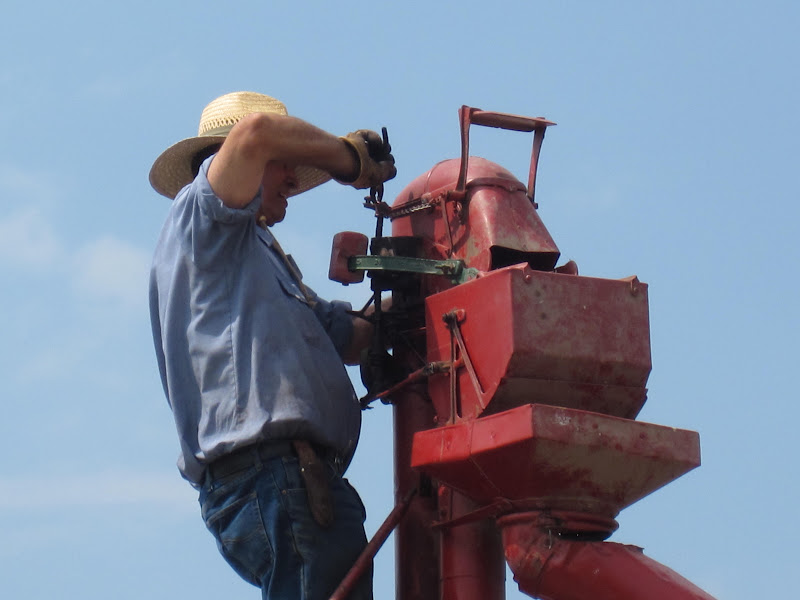
 Instead of the machine counting sacks as the 1898 Case Agitator, this machine actually weighs the oats and counts the number of bushels. The weight of the oats in the hopper is dumped into the auger when it exceeds the set weight of half a bushel as set by the counterweight.

There are lots of activities going on at the same time during the three-day event, and to answer all types of questions, the organization has an information booth, which was tended by our good friend, Betty Sticha, an active and long-time member of the club pictured in the information booth below:


Officer and Board Member, Harold Wondra was in charge of Preuhs Building where we exhibited, and in the photo below, Harold takes time in his busy day to pose as he drives the grounds to provide help to customers and workers during the three-day event.

Harold's wife Ellen watches the 25-minute photo display in our booth. She is a long-time friend of ours, and we were glad to discover she enjoyed the photos.

Customers and visitors kept us pretty busy, but during the two-hour parade of tractors, Nancy managed to snap a photo of our friend Dick Mushitz driving a Massey Harris that he restored.

Nancy and I had a great time exhibiting our photos and selling our books at the 39th annual LeSueur County Pioneer Power Show, but three days wasn't enough for us to get away to see the many other exhibits. However, if you put the third weekend after the first full week in August on your calendar for 2013, you could try to cover it all yourself. Stop in to say hello to us if you do. Go to their website at www.pioneerpowershow.com for more information.

Thanks to Harold Wondra for contacting us to exhibit and thanks to all of the hard-working members of  the club for making it all possible. Also, special thanks to Doug Hager for his time and expertise and to Shannon Prostrollo for reaching out to us to let us know about the amazing 1898 J.I. Case Agitator.
Hope to see you all again next year.

Photographs by Nancy A. Fredrickson


Monday, September 24, 2012

Farmamerica Fall Fair 2012

Farmamerica is 120-acre site near Waseca that was commissioned in 1978 to preserve and promote the strong heritage of Minnesota Agriculture.
They offer my books for sale in their gift shop, and they invite Nancy and me to special events at the farm site. Farmamerica has a really fine Interpretive Center, great historical buildings, antique machinery, and activities that are fun and accurately reflect our farm heritage.
Preserving farm heritage is a noble mission, and Nancy and I are proud and happy to be invited to show our farm heritage photo display and sell our books at Farmamerica's events.

On Saturday and Sunday, September 8 and 9, We set up our photo and book display in the lobby of the Interpretive Center and enjoyed visiting with staff and customers for the two-day Farmamerica Fall Fair, which included the following demonstrations: threshing oats, stalk shredding, corn picking, corn combining, corn shelling, baling, buzz saw, plowing, corn bundling, silage cutting, and various tractor and equipment displays. A tractor parade started at 1:30 each day.


While Nancy took care of our booth, I was able to sneak out and view most of the exhibits, but I forgot to get a photo of our booth. The above photo with me and a happy customer shows part of the display. The television on the left has a 25-minute photo display on a three-second timer showing photographs of farm activities from the early and mid-1900s.
I was particularly interested in getting photos of threshing like the one above 
that I can use in my next book, A Farm Country Harvest.
The steel-wheeled wagon and the braces on the rack on the left remind me of the rigs used when I was a boy, and the removable basket rack on the right is very much like a used one my folks bought in about 1955.
When I spotted this silage cutter, I knew I wanted photos that show all the detail on the machine because this is the same brand and cutter my folks used when they hauled bundles to fill their silo for so many years. Since I intend to write A Farm Country Silo Filling as my next book after A Farm Country Harvest, I'd been looking for a model for photos to send to my illustrator. My search is over.
I never tire of photos of threshing from the drive belt to the thresher.

We thank Jim Gibson, executive Director of Farmamerica, for inviting us to the Fall Fair, and thanks to Crystal and other staff members who made us feel welcome throughout the day. We especially thank the many board members who stopped by our booth to visit, to introduce themselves, and to give us encouragement in our efforts to preserve farm heritage.


Wednesday, September 19, 2012

Room for Growing

Pam, at Room for Growing, an educational child care facility in North Branch, invited me to do my Farm Heritage program for their 4-7 year old students in August. When we arrived, teachers made us feel welcome and showed us to a room to set up. Students and teachers projected curiosity and  enthusiasm throughout my program, and I think we all had some fun learning about farm life.
Students and teachers watch and listen as I begin my program, 
which included my story, If I Were a Farmer: Nancy's Adventure.

Experiencing the excitement of a room full of children and seeing the enthusiasm for teaching and love for children projected by teachers always provides me with a boost and reminds me how lucky I am to be part of it for a day.

When students exit after the program, they line up to stick their hands into a small can of oats to feel it.

In addition to the school at North Branch, Room For Growing Educational Child Care has facilities in Forest Lake North, Forest Lake South, and Chisago City.

Thanks to Pam for inviting me to do the program and thanks to all the teachers and students who made us feel welcome at the school.


Friday, September 7, 2012

Traveling Adventures


For Nancy and I, vacations are adventures where we seek to experience new places and meet new people. We've never had a vacation where we relaxed.
We figure we can relax at home.
We can sleep when we're dead.

We are both serious about learning about the nature of new places, and yet we are also both shameless tourist, eager to buy a trinket or tee shirt that will reflect the places we've been. (Nancy makes quilts from the tee shirts, but this is a subject for another blog.)

What makes a great vacation even greater is when we meet guides who love what they do and project their enthusiasm to travelers; when we meet fellow-travelers who politely take turns posing at a perfect picture site or ask if they can take our picture with our camera for us; and when we encounter restaurant servers and workers of all kinds who smile while doing their jobs serving the public, who take time to chat, and who make an effort to make a traveler feel welcome.

Let me give you a few examples from our recent trip to the Canadian Rockies.
We started planning our vacation rather late, and getting a reservation near Lake Louise, Alberta, Canada, was a challenge. After a few frustrating attempts to make a reservation on the Internet and a couple phone calls to places that did not fit our needs, we called Mountaineer Lodge. A lady by the name of Kat answered the phone and her spirited and friendly banter lifted our spirits as she quickly took the reservation. We stayed there two nights and it was perfect for us.

A short walk from the Mountaineer Lodge is the Lake Louise Station Restaurant, which is train depot converted into a fine dining restaurant. Yes, it is spendy, but the staff and food and atmosphere provide a special experience that you won't want to miss. Our waiter was James, and he provided great service and agreed to have his picture taken, as well as take our photo.
James took us outdoors to snap our photo (above),
and posed for a photo (below). 
James is a waiter who enjoys his work and passes that enjoyment onto his customers.


The next morning we left early to get to the Columbia Ice Fields where we had tickets for the bus which would take us to the Athabascar Glacier. We've seen glaciers before, but this was a chance to actually walk around on one. 
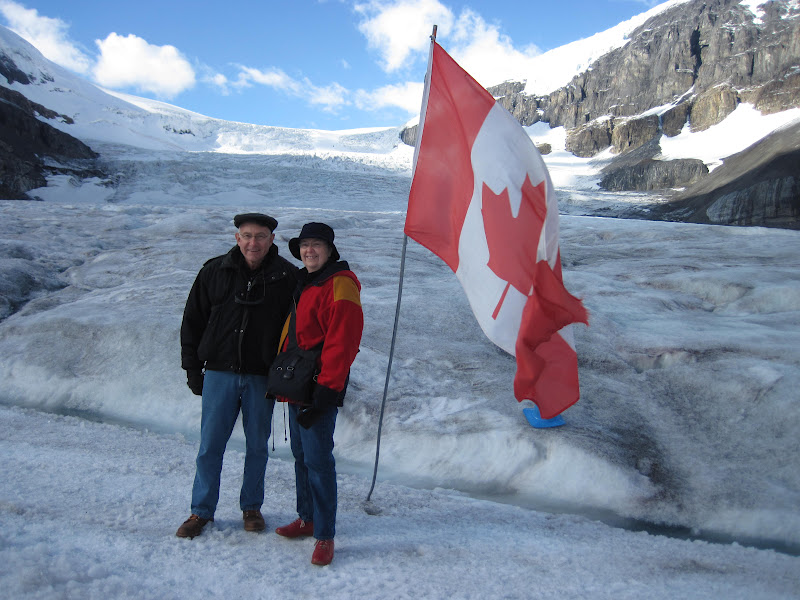
Here's Nanc posing in front of the Athabascar Glacier, which is the tongue of ice in the center of the photo. The Columbian Ice Fields stretch above and behind the glacier and cannot be seen in this picture. The glacier is over 7009 yards wide and over 3800 yards long, ending near the center of the photo where ice no longer exists. 

We arrived before the rush and the efficient staff got us on the first bus out, which loaded at 9:30 AM, and took us on about a ten-minute ride to the where we would board the specially-made, buses that drive on the glacier. On the short ride to the glacier, the driver and guide introduced themselves, and the guide began explaining the mountains and glaciers surrounding pour trek. These two men seemed to love what they do, while they made the short trip interesting and fun.
The driver, Roy, gave  big smile as Nancy snapped his photo. We didn't get a photo of the guide.

We debarked the bus at a station a short distance from the glacier, and climbed aboard buses especially made to drive on the glacier. 
These buses were especially designed for use on glaciers. They are manufactured near Banff, Canada, and 22 of the 23 in existence are used by this company giving tours around the Banff area and the Athabascar Glacier. Another is in use in Antarctica.
This bus took us down a 32% grade for about a 100 yards to a small man-made pool, which the driver slowly drove through to clean mud off the tires so they would not bring dirt onto the glacier.
Bruce, our driver, was very knowledgeable and clearly loved his job. He told stories and explained facts about glaciers during the ten-minute drive to the turn-around area near the middle of the glacier.
Before we get off the bus, Bruce explains the dangers of cervices in glaciers and reminds us to only walk on the safe area, which had been graded and checked for safety earlier in the morning.
The photo of me by the bus gives you an idea of the size of the tires.
Bruce carefully checks out the glacier (above), while Nancy and I (below) have a fellow-traveler take our photo standing in the safe zone with the top of the glacier behind us.


Bruce plants the flag and takes our photo by it (above),
 and then Nanc takes a photo of Bruce by the flag (below).


The temperature was cold but pleasant on the glacier and we hated to leave, but we knew our 20 minutes was almost up when we saw another bus approach the turn-around area. Soon after, we loaded ourselves onto the bus and began the trip back. 
Bruce continued to enthusiastically explain more about glaciers. 
For example, why are glaciers bluish?
 It starts with the fact that all snow begins by moisture gathering and freezing on natural particles of dirt in the atmosphere. Snow that is not under pressure contains more oxygen, and since oxygen reflects all the colors of light, regular snow appears white. 
However, glaciers are snow that has been under a great deal of pressure, which has squeezed out the oxygen and the particles of dirt reflect the spectrum of blue light. 
In the center of the photo above, you can see the bluish tint of the snow near the bottom of the packed ice. Bruce explained that the reason more blue did not show up other places is because fresh snow had fallen during the night. The fresh snow is not packed and is, therefore, white, but as the sun melted the new snow, the bluish color of the packed snow and ice showed through.
Next question: why is glacial water bluish?
Before the ice melts, the pressure and movement of the glacier grinds the dirt particles into a fine powder called glacial flour, which colors the water bluish as can be seen in glacial runoff and glacial lakes. Once we changed buses and headed down the mountainside for the brief ride back, our driver and guide, Caroline, who had a beautiful French accent, pointed out two streams running down the mountain. One stream had bluish water, which came from the glacial melt. The other stream had clear water that came from a nearby spring. Sorry we couldn't get photo of the contrasting streams, but don't take my word for it, visit the Columbia Ice Fields to check it out for your self.

A day later we drove south through western Alberta, eager to visit the Head-Smashed-In Buffalo Jump near Ft. Macleod, Alberta. A Buffalo jump is a site where Native Americans, called First Nations in Canada, have herded buffalo over a drop off to kill them for food. Head-Smashed-In was used from 5500 years ago to the mid-1800s and gets its name from a young brave who stood under the cliff watching as many buffalo were riven over the edge. For him it was much like standing under a waterfall as water flowed over in front of him like water, but as the buffalo piled up, he found he could not escape. He was later found with his head smashed in.


One the way to the jump, we stopped at the Claresholm Museum and Visitors' Center where we met Bob, who was so enthusiastic about his job of helping people find exciting things to do in the area that we came out of the place with all sorts of maps and books and facts. The museum itself offers a treasure of antiques clearly displayed and described, but it was Bob's personal attention to the visitors that made the place an excellent stop.
The Head-Smashed-In Buffalo Jump Interpretive Center is built into the hillside with the entrance on the lower level on the bottom of the photo. The building rises up six stories to the top of the cliff where visitors can walk out upon the very trail the buffaloes followed before they plunged to their deaths.


When we entered the building, we were greeted by Leandra, a smiling guide with a fun sense of humor, who we visited after the tour as she shared stories with us. The place is lucky to have her. She quickly explained to us that we should start the tour by going up to level six and walking on the top of the cliff.

Nancy holds onto her hat. The wind on the cliff top was powerful and loud. It blew over a three-year-old child as she tried to stand on a rock. No damage done to the child, but we thought it inappropriate to snap a photo of the kid's attempts. The wind was a loud as a freight train and prevented most conversation. Most visitors left rather quickly, but it was an experience we will remember.

After viewing the museum's artifacts on all six floors, we exited to walk along the base of the cliff and found that the area where the buffaloes died was now overgrown with chokecherry bushes, a fitting destiny for the land, since chokecherries were one of the berries First Nations used to mix with dried buffalo meat to make pemmican, which they ate during winter months.
We used the timer to snap a photo of the two of us by the sign as we left.


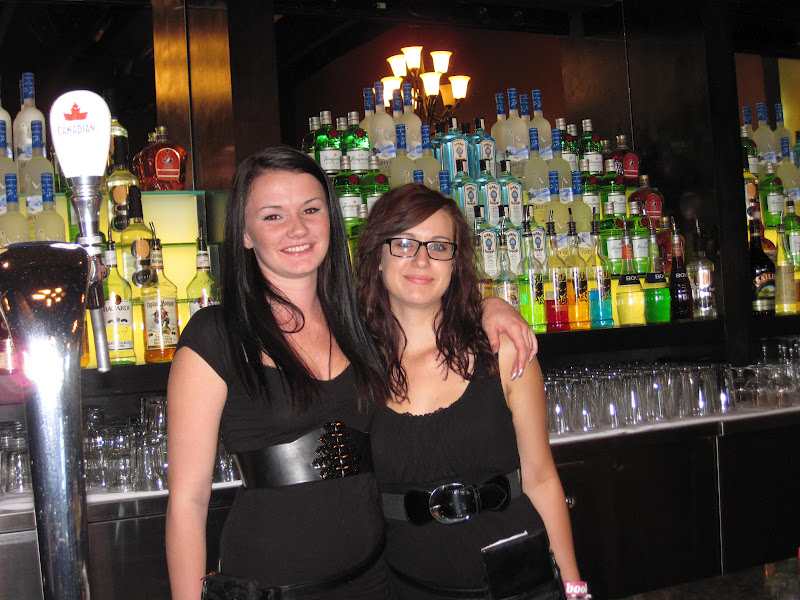
We drop on to Lethbridge to stay the night. Next to our motel was Mr. Mike's Steakhouse Casual, where we encountered Kyla, a friendly bartender who shared stories about her grandparents who came to Alberta. Kyla clearly liked her job and made our evening a fun event. 
We took her photo (above), and she took our photo (below).

The next day we drove south across the boarder, east across Montana on Highway #2, and stayed at a hotel at Williston, ND. 
Some of the temporary housing near Williston, ND.

Williston is experiencing an oil boom, and temporary housing lined the highways as we drove into town. Road construction was all around, struggling to keep up with the influx of cars and people. Once we found our hotel, we didn't want to move the car so we walked a short distance to a family restaurant, which was clearly understaffed. I give credit to the hard-working cooks and servers who hustled to keep up with customer orders. On the way out I noticed a sign above a pile of forms. The sign said, "If you have a complaint, please take one." The form was an application to work at the restaurant. 


Early the next morning we drove to the North branch of Theodore Roosevelt National Park. This was our third attempt to visit the place over a period of ten years. Each time roadwork in the park prevented our visit. This time, the friendly ranger told us about half of it was open so we could drive into the park about six miles. He said that the soil in the park made very poor roadbeds and roads had to be repaired often. He was very helpful and interesting. He showed us a 15-minute film that reminded me of the important role the Civilian Conservation Corps (CCC),  a program created by Teddy's cousin, President Franklin Delano Roosevelt, played in developing many parks into places the whole family could enjoy. TR was a leader in designating park and monument lands, and he deserves total credit for starting a conservation movement that led to our modern park system. However, without the expenditures for roads, trails, and buildings built by the CCC, the parks would not have been accessible to most of us for the past 80 years or so. 

We stopped at Medora and drove on to Fargo to stay overnight at a Wyndham Hotel. During check-in the ladies at the desk welcomed us with free hors d'oeuvres and drinks. After a day of driving and touring, nothing was more welcome. Great timing!


Later, we walked across the parking lot to the Space Aliens Bar and Grill (above), where we were welcomed and served by Lyndsey and her friend from behind the bar, Paul (below).
Lyndsey generously spent time chatting with us and helped make our evening enjoyable.

This was our final overnight stay on our travels. The next morning we left fort Buffalo River State Park in Minnesota, where we walked on paths for a coupe hours and visited with the friendly, knowledgeable rangers.

During the drive south to our home near Lakeville, we discussed our trip. It was eight days since we had crossed the border into Canada and entered Saskatchewan for the first time. We loved viewing the wheat fields as far as we could see, and we never tired of witnessing farmers scramble to get their harvest done. 
After driving about 10 hours to Strathmore, Canada, on the first day of our travels, we were particularly glad to get to our hotel and sit down to eat.
Nancy and I with our supper (above) at the Roadhouse Restaurant in Strathmore, SK, 
and our friendly, hard-working servers, Samantha and Christina (below).


Exiting the restaurant, we met Strathmore native Dan,  as Nancy was taking a picture of me by the door. Dan told us a bit about his travels, living in Texas, and how he enjoys coming home regularly.
Then he insisted on taking our picture together (above) and he agreed to pose with me for a photo (below).


Since I was trying not to overwhelm, the photos I've included show only a fraction of the places we visited and enjoyed, but my focus is on on all of the great people who make a great vacation adventure even greater just by enjoying doing their jobs and passing on their enjoyment to those they serve.

One more thing: Nancy and I wish to thank all of those border officials who have the difficult job of trying to discover who to check closely at borders. Obviously, I didn't ask to take their photos, but we should all recognize that these men and women do a great job day after day.